
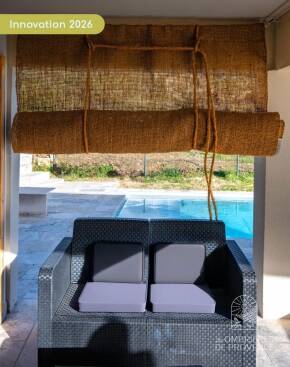

Main features:
- Natural shade
- Open top hem
- Soft finish
- Easy installation
- Vertical opening
- 3 sizes
- Made-to-measure possible
Coconut fiber roll-up blind: adjust the shade to the height you want
The only product in the range that adjusts throughout the day
While standard curtains slide to the side, this blind adjusts vertically. It is a difference in function rather than material: at 1:00 PM, you unroll it fully to block the midday sun; at 6:00 PM, you raise it halfway to regain the view without letting the heat back in; and in the evening, you roll it up completely. The blind stays in your chosen position, allowing you to control the amount of shade rather than choosing between fully open and fully closed. This flexibility makes it particularly suitable for shifting sun exposure—such as a west-facing gable, a terrace side grazed by the sun in the late afternoon, or a large window hit directly by midday light. For a panel that opens sideways and is then left in place, sliding loop curtains are a better fit.
A 60 mm top hem—no extra hardware needed
Installation simply involves sliding a rod through the top hem, which has an internal diameter of 60 mm. Any bar, rod, or tube smaller than 60 mm works, including those already installed on many pergolas and awnings. No mechanisms, no housing units, and no heavy-duty drilling: it is the quickest installation in the entire curtain range, and just as easy to take down. Whether a storm is forecast, you’re heading away for the weekend, or the season is ending sooner than expected—simply roll it up, slide out the rod, and the blind is packed away in two minutes. A new addition for 2026, it is also the only model in the range that is fully biodegradable, as it contains no metal parts.
Three sizes, including one designed for low-profile applications
Three sizes are available: 1.5 x 2 m, 2 x 2.5 m, and 2 x 1.5 m. The first two cover standard terrace and pergola heights. The third—wider than it is tall—addresses common needs: screening a balcony railing, extending the height of a terrace balustrade, or raising a low wall without blocking the view above. For these partial installations, it is best to choose a blind slightly wider than the area to be covered so that sunlight doesn’t slip in at the edges when the sun is low. Whether poolside or facing the sea, the open weave offers distinct advantages: it filters light without creating a solid wall, and wind resistance remains very low.
Fiber characteristics and maintenance
The woven material weighs 900 g/m² when dry and doubles in weight when wet before regaining its tension upon drying; the support rod must therefore be sized to handle the wet weight, and it is best to avoid rolling up the blind while it is still damp. The fiber is water-resistant, does not retain moisture, and does not rot. Occasional washing with mild soap is sufficient, and during prolonged dry spells, an occasional misting helps extend its lifespan. The color gradually shifts to a silvery gray without compromising performance. For winter storage, keep the blind in a dry, well-ventilated area protected from rodents. If none of the three standard sizes fits your opening, custom-made options are available based on your exact measurements. The rest of the collection is featured in the coconut fiber curtains category, including the grommet-style coconut fiber curtains designed to open from the side.


Main features:
- Natural shadow
- Open hem top and bottom
- Soft rendering
- Easy installation
- Can be opened
- 2 sizes
- Made-to-measure possible
Open-hem coconut fiber outdoor curtain: a taut panel, not a sliding curtain
The right choice for a fixed curtain
Not all outdoor curtains are meant to be opened and closed ten times a day. The open-hem model is designed to remain taut: install it on the side of a pergola exposed to low late-afternoon sun, at the back of a gazebo, between two posts to enclose a patio corner, or as a lightweight partition between a dining area and a walkway. It is not designed to slide along its rod—which is precisely what gives it such a uniform drape, free of folds or bulky bunching. To open it, simply lift the panel to the side and secure it with a rope or tie-back. If, however, you are looking for a curtain to handle daily, consider the loop-top sliding coconut curtains or the grommet-style sliding coconut curtains, both of which are constructed to withstand repeated sliding.
Two 60 mm hems: what this means for installation
The curtain features a hem at both the top and bottom edges, with an internal diameter of 60 mm. In practical terms, the curtain slides onto its support—such as a rod, metal bar, wooden batten, tube, or steel cable—like a sock. Anything that fits through a 60 mm opening is suitable, provided there is enough clearance to avoid straining the fiber. The order of operations matters: first slide the bar into the hem, then attach the ends to the supports—never the other way around. For a 2-meter width, it is best to avoid overly thin rods, which would visibly sag in the middle. A detail often overlooked: the bottom hem isn’t just for show. Sliding a second bar into it transforms the panel into a taut screen that won’t flap in the slightest breeze—this simple step makes the difference between a curtain that hangs beautifully and one that bangs against the post.
900 g/m²: filtering light rather than blocking it
With a dry weight of 900 grams per square meter and a thickness of one centimeter, this weave is intentionally designed to be less dense than full blackout screens. It intercepts direct rays, cuts down on glare, and lowers the perceived temperature behind it, all while allowing soft, diffused light to filter through—so you aren’t left in the dark under the pergola at the end of the day. The mesh remains breathable, allowing air to pass through, and wind resistance stays very low for a panel of this height—a crucial factor for a pergola where the curtain is fully exposed. If your priority is blocking the view from neighbors rather than softening the sunlight, you should look at the category’s blackout screens; the hemmed curtain, by contrast, focuses on ambiance and thermal comfort.
Sizes, durability, and winter storage
Three sizes cover the most common configurations: 1.5 x 2.2 m, 1.5 x 2.8 m, and 2 x 2.5 m. Note that the usable height is slightly reduced once the bars are inserted into the hems—something to factor in when measuring the clearance under your beams. Also, anticipate how the fiber reacts to moisture: the weave stretches when wet and its weight doubles, then it tightens back up as it dries. Consequently, the rod and brackets—sized for the dry state—will be subjected to greater stress during every downpour. The rest of the maintenance is minimal: an occasional wash with mild soap suffices; the fiber is rot-resistant and slowly turns a silvery-grey without losing any of its effectiveness. At the end of the season, the panel can be stripped of its bars, folded or rolled up, and stored in a dry, well-ventilated place safe from rodents—ensuring it lasts for several more seasons. Other models in the range can be found in the coconut fiber curtains category.
Main features:
- Natural shade
- Sun Protection ++
- Very large shaded area
- Technical installation
- Crank handle opening
- 2 sizes
Discover the benefits of our cantilever coconut fiber parasol
Natural, durable sun protection with authentic style
Add a touch of the exotic and refreshing shade to your outdoor spaces with our cantilever parasol made from natural coconut fiber, mounted on a reinforced aluminum pole. Ideal for terraces, beaches, pool areas, or gardens, this parasol combines rustic elegance with technical performance. The coconut fibers naturally filter UV rays while allowing air to circulate, creating an airy, pleasant, and visually unique shaded area. Its natural, bohemian look makes it a standout decorative feature while ensuring optimal thermal comfort. Explore our full range in the coconut parasols category.
Structural strength and weather resistance
Built to last, our parasol features a reinforced aluminum pole and ribs, ensuring maximum resistance to wind, impact, and corrosion. Unlike untreated wood or steel structures, the powder-coated aluminum used does not rust, even in salty environments. The coconut fiber is resistant to UV rays, moisture, and changing weather conditions, allowing for year-round use—even in challenging conditions such as the Mistral, Tramontane, or strong sea breezes.
Easy installation and versatility for any setting
Available in various diameters, our cantilever parasol is suitable for both private spaces and professional environments (hotels, restaurants, seaside resorts). Depending on your space layout, you can choose a round center-pole parasol—perfect for shading a lounge area or a round table—or a rectangular center-pole parasol, which is better suited for long dining tables and elongated terraces. It can be installed directly on a terrace using a suitable weighted base. Assembly is straightforward, thanks to a design that allows for quick setup by two people without the need for complex tools.
A natural, customizable parasol with a warranty
We offer several standard sizes as well as custom manufacturing to meet the specific needs of each project. Whether you wish to cover a relaxation area, a dining spot, or a large terrace, we will help you select the right model and dimensions. Each parasol comes with a 2-year warranty and a comprehensive installation guide. To extend its lifespan, we recommend storing it away during long periods of non-use. It is also possible to replace the canopy fabric on your parasols. For more information, please refer to the custom parasols section.
Main features:
- Natural shade
- Sun Protection ++
- Large shaded area
- Quick and easy to install
- Manual opening
- 1 dimension
Rectangular center-pole parasol: covering a long table without overkill
Why a rectangle instead of a round shape?
It is not a question of aesthetics, but of arithmetic. To keep the ends of a two-by-one-meter table shaded, a round parasol would need a three-meter diameter—meaning most of that shaded area would fall beside the table, into empty space. A rectangular parasol follows the shape of what it protects: less fabric, less wind resistance, and a smaller footprint, all while providing more complete shade. It is therefore the ideal choice for large dining setups, long terraces, rows of sun loungers, and covered walkways. For a garden lounge set, a round table, or a square space, the round center-pole parasol remains the right choice.
The center pole: greater stability, less ballast
This is the technical difference compared to a cantilever model, and it works in favor of the center-pole design. The load travels vertically down the axis of the pole without creating leverage; consequently, the required ballast is significantly lower for the same amount of shade, the structure withstands gusts better, and the footprint is limited to the base itself. The powder-coated aluminum pole and ribs do not rust—even in salty air—and withstand repeated opening cycles without developing looseness. There is, of course, a trade-off: the pole passes through the shaded area. If you have a table with a central hole, this is a non-issue; if your furniture cannot accommodate a pole, the offset rectangular sunshade leaves the entire area underneath clear, though it requires a heavier base.
Coconut fiber: what to know before buying
The natural weave filters light rather than blocking it and allows air to pass through the canopy, preventing the stifling heat often felt under a standard parasol in the late afternoon. It is also a living material: the color evolves from season to season, darkening slightly—part of the appeal for those who prefer it over the uniform look of synthetic fabrics. Maintenance is minimal, requiring only a dry brushing at the start of the season. However, the material does not fare well if left damp inside a closed cover; the parasol should be folded when dry and stored indoors during winter. Other versions of this product are available in the coconut fiber parasols category.
Dimensions, custom manufacturing, and re-covering
The key factor is not the size of the parasol itself, but the size of the area requiring shade during your intended hours of use: a table seating eight people requires a different amount of overhang at noon compared to 6 PM. Several standard sizes are available, with custom manufacturing options for cases where standard sizes don’t fit—such as for professional use, restaurant terraces, or specific installation constraints. Comes with a 2-year warranty and instructions; assembly requires two people and no special tools. Since the canopy is the part that shows wear first, it can be replaced independently without changing the structure: see the custom parasols section.
Main features:
- Natural shade
- Sun Protection ++
- Medium shade surface
- Quick and easy to install
- Manual opening
- 1 dimension
Round center-pole parasol: the most versatile shape
Symmetry: an underrated advantage
A round parasol casts the same shadow in all directions, regardless of the time of day. As the sun moves, the shaded area remains centered on the pole; there is no need to reorient or shift the parasol between lunch and drinks. This makes it the go-to choice for round or square tables, garden lounge sets, reading nooks, or relaxation areas with no specific geometric layout. It is also forgiving regarding placement—a poorly oriented rectangular parasol might leave a corner exposed to the sun, whereas a round one has no specific orientation. Conversely, if your space is distinctly elongated, the rectangular center-pole parasol will cover the same usable area with less canopy fabric.
Ease of setup
It is the simplest model to install: a weighted base on the patio, a pole, and the job is done. The load is distributed vertically without leverage, minimizing the required ballast and footprint compared to a cantilever model. The powder-coated aluminum pole and ribs are rust-proof—even in seaside locations—and withstand repeated opening cycles without becoming loose or wobbly. It can be opened and closed by one person in seconds—a feature that matters more than you might think for a parasol used daily. However, the pole does occupy space within the shaded area; if your furniture cannot accommodate this, the Offset rectangular sunshade leaves the entire area unobstructed.
The benefits and requirements of coconut fiber
The natural weave filters light rather than blocking it and allows air to pass through the canopy, avoiding the stifling, trapped-heat effect often felt under a standard parasol in the late afternoon. It is a living material; its color deepens slightly over the seasons—a transformation that is part of its unique appeal. Maintenance simply requires a dry brushing at the start of the season. The only thing to watch out for is leaving it damp inside a closed cover. Fold the parasol when dry and store it indoors for the winter, and it will last for years. Other versions of this material can be found in the coconut fiber parasols category.
Choosing the diameter, custom options, and canopy replacement
The key factor isn’t just the listed diameter, but the desired overhang around the table: allow for about fifty centimeters of canopy extending beyond the table edge so guests stay shaded as the sun lowers. A table for four requires a different model than a table for eight; we are happy to help you decide based on your specific dimensions. Several standard diameters are available, with custom manufacturing options for professional use or specific installation requirements. Comes with a 2-year warranty, instructions, and is designed for two-person assembly without special tools. Since the canopy is the part that ages first, it can be replaced independently without altering the structure—see the custom parasols section.
Main features:
- Natural shade
- Sun protection ++
- Pergolas & arbours
- Rope included
- Easy installation – 2 pers
- 17 dimensions
- made-to-measure possible
Discover the benefits of our dense coconut shade cloth for pergola
Natural and stylish sun protection
Our coir shade cloth for pergola is designed with a simple weave to provide natural shade and unrivalled coolness under any outdoor structure. These natural fibre fabrics act like a natural air conditioner, filtering out the sun’s rays while allowing light to pass through, creating a protected yet bright outdoor space. Thanks to their eco-friendly and timeless design, they sublimate your exteriors, bring a decorative and bohemian trend.
Adaptability and easy installation of the shade on your pergola
Compatible with all structures, whether made of wood, metal or wrought iron, our shade cloth fits perfectly whether your pergola is freestanding, leaning against the house or free-standing. Fitting the canvas is made easy with the 0.5 mm rope supplied, allowing simple installation by two people, depending on the dimensions you choose, right up to a made-to-measure service to suit all requirements.
Resistance and durability
Made from natural coconut fibres, our canvas is not only stronger but also more weather-resistant than synthetic or natural materials such as bamboo or canisse. It maintains its integrity even in the face of strong winds (Tramontane, Mistral, Sirocco, Autan, Alizé and sea storms on the coast, for example) and harsh winter conditions. For the most exposed areas, our Coco Robusta shade cloth offers reinforced resistance. Its rot-proof nature ensures increased longevity, is water-resistant and requires no special maintenance, apart from recommended wintering to maximise its lifespan.
Practical advice and customisation for every pergola
To cater for all configurations and preferences, we offer a range of standard sizes as well as made-to-measure options. Questions frequently asked by our customers, such as selecting the right size or assembly instructions, are addressed in our detailed installation guide. In addition, our canvases come with a 2-year warranty, reflecting our commitment to quality and customer satisfaction.
Main features:
- Natural shadow
- Eyelets on cotton braid
- Soft finish
- Easy to install
- Quick and easy to open
- 2 sizes
- Made-to-measure possible
Coconut fiber sliding curtain with eyelets: the charm of antiqued brass, indoors and out
A finish that stands out
With this model, the curtain header does more than just hold the panel in place—it is part of the décor. The eyelets are made of “Antique Brass” and set onto a cotton header tape; their dark patina contrasts beautifully with the warm tone of the coconut fiber. It is a finish that catches the eye up close—as you walk past the curtain throughout the day—and truly comes into its own on a terrace with character, featuring elements like old stonework, wrought iron, or vintage furniture. The eyelets also have a subtler yet equally noticeable effect: they distribute the fabric into even folds, allowing the curtain to hang with a uniformity not found in other systems in the range. For a panel that is often left open and folded to one side, this draping makes all the difference.
40 mm eyelets: what this means for installation
The inner diameter is 40 mm—ten millimeters larger than that of the loop-style sliding curtains. In practical terms, this expands your choice of mounting hardware: a substantial curtain rod or a thick wooden batten will fit easily, whereas loop-style curtains require something slimmer. If your pergola already has a bar, rod, or tube installed, measure it before ordering—there is a good chance it will work as-is. While a tensioned steel cable remains an option and offers the smoothest sliding action, it is not the ideal choice here; a wide eyelet slides better on a rigid support that keeps the curtain header properly aligned.
Brass does not rust, resolving any concerns about exposure to the elements, and the cotton binding withstands daily use without a hitch.
The only model in the range suitable for indoor use
This is a use case we hadn’t anticipated but which customers discovered on their own: the curtain works beautifully indoors. In a living room, it serves as a flexible partition between spaces, filters light from a south-facing window, or conceals a storage area without completely closing off the room. The raw texture of the fiber and the patinated brass complement interiors featuring wood, polished concrete, or terracotta tiles, while the weave allows enough light through to keep the room bright. For indoor installations, it is best to choose a size slightly taller than the opening so the bottom of the curtain touches the floor, helping it stay in place. Worth noting for the eco-conscious: the fiber is bio-based and fully biodegradable—the metal eyelets being the only exception.
Four sizes, weighting, and durability
Four sizes are available: 1.4 x 2.4 m, 1.5 x 2.2 m, 1.5 x 2.8 m, and 2 x 2.5 m. The 60 mm bottom hem accommodates a weighting bar or rod—useful outdoors to prevent the panel from flapping in the wind, though unnecessary indoors. The fiber weighs 900 g/m² when dry and doubles in weight when wet, regaining its tension as it dries; the mounting hardware must be rated to handle the wet weight. This is precisely where the difference in diameter compared to loop-based systems matters: a 40 mm eyelet requires a sturdier rod. Occasional washing with mild soap is sufficient; the color will naturally shift to a silvery-grey without any loss of effectiveness. For winter storage, keep the product in a dry, well-ventilated area protected from rodents. If none of the four standard sizes fits your needs, a custom-made coir curtain can be produced based on your specific measurements. The rest of the range is featured in the coir curtains category, including open-hem coir curtains, designed for panels that remain permanently tensioned.
Main features:
- Natural shadow
- Curls and heart pods
- Soft rendering
- Easy installation
- Quick and easy to open
- 2 sizes
- Made-to-measure possible
Open hem coconut outdoor curtain: a taut panel, not a sliding curtain
The right choice when the curtain stays in place
Not all outdoor curtains are meant to be opened and closed ten times a day. The open hem model is designed to remain taut: it is installed on one side of the pergola exposed to the low, late afternoon sun, at the bottom of an arbor, between two posts to close a corner of the terrace, or as a light partition between a dining area and a passage. It is not designed to slide on its rod – this is what gives it this regular drape, without folds or excess thickness. The opening is done laterally, by raising the panel on the side and embracing it with a rope or tie. If, on the contrary, you are looking for a curtain that can be handled daily, turn to the sliding coconut curtains with loops or to the sliding curtains with eyelets, the manufacture of which is intended for repeated sliding.
Two 60 mm hems: what changes it makes when installing
The confection has a hem on each of the two widths, top and bottom, with an internal diameter of 60 mm. Concretely, the curtain is slipped like a sock on its support: rod, metal rod, wooden cleat, tube or steel cable – anything that passes within 60 mm is suitable, keeping a little play so that the fiber does not strain. The order of operations matters: first thread the bar into the hem, then attach the ends to the supports, never the other way around. On a width of 2 m, it is better to avoid rods that are too thin which would have a visible sag in the center. Often overlooked point: the bottom hem is not decorative. Slipping a second bar into it transforms the panel into a taut screen which no longer flaps at the slightest breath – it’s the gesture which makes the difference between a curtain which is enjoying its season and one which slams against the post.
900 g/m²: filtering light rather than cutting it
With 900 grams per square meter dry for one centimeter thick, this weave is deliberately set back from blackout screens. It intercepts direct rays, breaks the glare and lowers the temperature felt behind it, while allowing subdued light to filter through: you don’t find yourself in the dark under the pergola at the end of the day. The mesh remains ventilated, the air passes through it, and the wind resistance remains very low for a panel of this height – a decisive point on a pergola where the curtain works on the full facade. If your priority is to eliminate a view rather than to soften the sun, it is towards the blackout screens of the category that you should look; the hemmed curtain plays on the atmosphere and thermal comfort.
Formats, durability and wintering
Three dimensions cover the most common configurations: 1.5 x 2.2 m, 1.5 x 2.8 m and 2 x 2.5 m, knowing that the useful height is slightly reduced once the bars are engaged in the hems – to be included when measuring your height under the beam. Also anticipate the behavior of the fiber in humidity: the weave relaxes in the rain, the mass doubles, then the tension returns when drying. A rod and supports sized for dry conditions will therefore be used more with each downpour. The rest of the maintenance requires just a few things: an occasional wash with mild soap is enough, the fiber is rot-proof and slowly turns towards a silvery gray without losing any of its effectiveness. At the end of the season, the panel is removed from its bars, folded or rolled up, and stored in a dry, well-ventilated place, protected from rodents – a few more seasons at stake. The other models in the range are grouped together in the coconut curtains category.
