

Main features:
- Blackout screen
- Low wind resistance
- Intense shade
- With rope included
- Easy installation
- 2 sizes available
- Custom size possible
Balcony privacy screen: regain your privacy without weighing down the railing
Balcony privacy: a different challenge than a garden fence
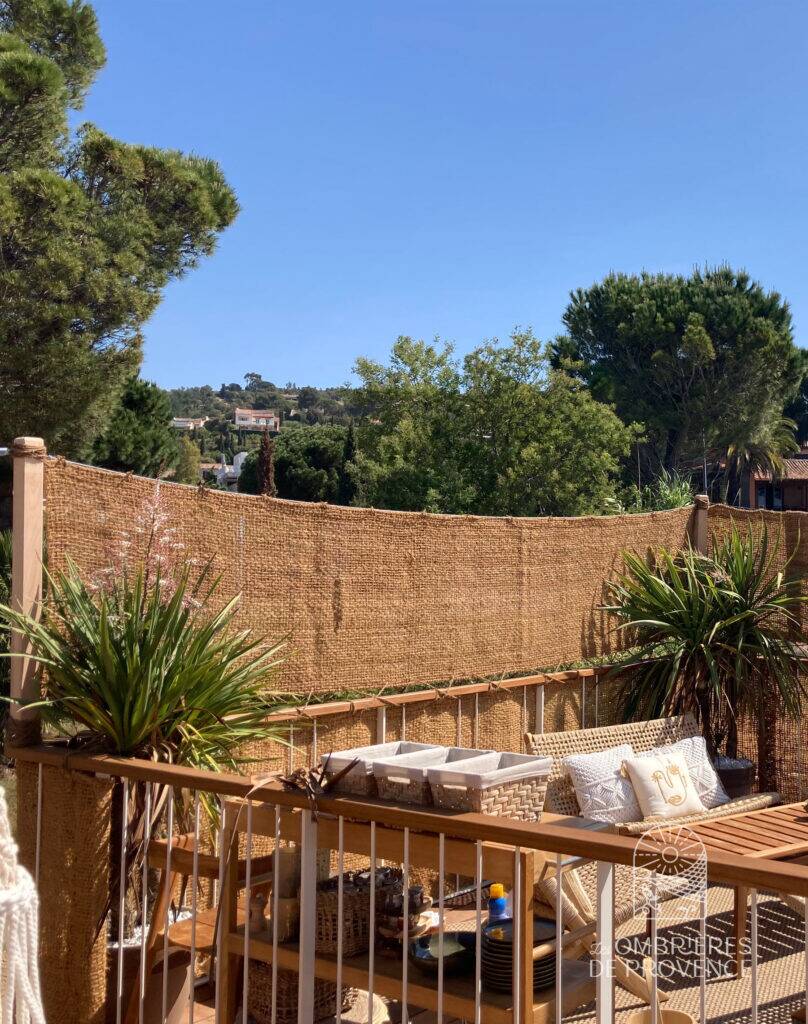
On upper floors, sightlines don’t just come from straight ahead but from above, below, and angles: a neighbor’s window looking down at your table, a shared walkway, the street and its bus stops, or the building opposite just fifteen meters away. There is also a constraint gardens don’t face: space is at a premium, and anything that blocks light comes at an immediate cost to comfort. The Coco Robusta balcony privacy screen addresses this specific scenario—a vertical screen attached to the railing that blocks the line of sight at seat and coffee-table height (where balcony life actually happens) without rising up like a curtain above the balustrade. For garden fencing, a terrace return, or a long stretch of wire mesh, you should look at the ultra-dense coconut privacy and wind screen: same fibers, but much larger formats.
Two sizes tailored to standard railing heights
The product comes in 2x2m and 2x3m sizes, matching common railing dimensions: a continuous balcony can be covered by placing two panels side-by-side, while a small balcony or loggia can be fitted with a single piece. The screen is installed lengthwise along the railing; any excess height can be folded inward or secured with ties at the bottom. A practical tip: it is better to choose a slightly larger size and take up the slack by folding the edge over, rather than cutting the border, because the 17mm perimeter rope is what prevents the weave from unraveling over time.
Securing to a railing: bars, glass, or sheet metal
Installation involves tying the panel in place using the two 0.5 cm coir rope coils supplied with it. On a metal bar railing, the rope is threaded directly between the bars: space the attachment points closely at the top and further apart at the bottom. For glass railings or solid sheet metal panels, an intermediate anchor point is required—such as a handrail, bottom rail, or intermediate tube—since the material cannot hold itself up through tension alone. You must also account for the cantilever effect: balconies act as projecting structures, and the screen becomes significantly heavier when wet (returning to its original tension as it dries). Therefore, distribute the attachments rather than concentrating the load on just three knots, and avoid leaving a loose section on the street side that could flap in the wind.
Wind at height, light levels, and winter removal
Apartment balconies are exposed to wind gusts not found in ground-level gardens: wind acceleration between buildings, corner eddies, and updrafts along the façade. The weave remains open, allowing air to pass through rather than pushing against the material—this is precisely what makes it possible to install a high-opacity screen at height without turning the railing into a sail. Regarding light, expect a significantly more shaded balcony: for north-facing spots or already dark loggias, it is better to cover only half the length or opt for the “Classique” range dense coir screen, which offers a brighter look. Finally, the material can be folded and rolled without retaining crease marks: it can be taken down at the end of the season, stored in a dry place, and reinstalled in the spring—a practical flexibility for situations where condo regulations require periodic façade maintenance. All coconut-fiber screens, curtains, and blinds are grouped under the curtains and screens category.

Main features:
- Semi-occulting screen
- Wind resistance ++
- Natural shade
- Can also be used as a dense fabric for pergolas
- Rope included
- Easy to install
- Stretched appearance
- 16 dimensions
- Made-to-measure possible
Ultra-dense privacy and windbreak screen: block the view, not the breeze
When maximum privacy is truly called for
Not all situations involving overlooking neighbors require the same solution. The ultra-dense weave of the Coco Robusta range is designed for situations where total privacy is essential: a neighbor’s window facing directly onto your terrace, a ground-floor garden in a housing development, an exposed spa or pond, an urban courtyard surrounded by buildings, or a seaside spot where you want to shield yourself from both passersby and gusty winds. At this level of density, the screen blocks not just direct lines of sight, but also silhouettes and movement behind the barrier. If your needs are more modest—such as defining two zones within the same garden, dressing up a shared boundary fence, or concealing a garden shed without darkening the back of the plot—the dense coconut screen from the Classique range is a better fit, as it allows more light to pass through. A full comparison of the two weaves can be found in our guide on choosing the right privacy screen or windbreak.
1,600 g/m²: what this density means in practical terms
One figure sums up the difference compared to a standard screen: 1,600 grams per square meter (dry weight), with a thickness of approximately one centimeter and a 17 mm perimeter rope that secures the edges and prevents fraying. This mass of fiber creates the privacy effect but also casts a much deeper shadow—which is why the same panel can be installed horizontally as an ultra-dense shade canopy on a pergola when solid, deep shade is desired. A key point: despite its density, the fiber remains woven rather than airtight. Air continues to pass through the mesh, preventing the “ballooning” effect associated with solid panels and explaining the low wind resistance observed in installations exposed to winds like the Mistral or Tramontane. The result is near-total visual opacity without turning the screen into a sail that catches the wind.
Mounting a heavy screen: the support structure matters more than the material itself
Installation involves tying the screen in place using the 0.5 cm coir rope supplied with the panel; using an installation needle saves significant time and protects your fingers when working on large areas. A crucial factor to consider is the weight when wet: upon contact with water, the weave expands and the material’s mass doubles—reaching around 3,200 g/m²—before returning to its original tension as it dries. Consequently, a support structure sized only for dry conditions will be subjected to loads exceeding its design limits during every rainfall. In practical terms, this means using posts that are either concreted in or securely guyed, opting for rigid rather than flexible fencing mesh for tall installations, and spacing tie points closely along the top edges. For balcony railings—where cantilevered weight and often condominium regulations come into play—the Coco Robusta balcony privacy screen is the specific product designed for this use.
Dimensions, custom sizing, and lifespan
Sixteen standard sizes are available, ranging from 2×2 m to 4×7 m, covering most fencing and terrace return needs; for larger dimensions or specific height requirements (such as fitting under a lintel), custom sizing avoids the need for cutting, which can compromise the integrity of the edges. In terms of longevity, the Robusta range comes with a 3-year warranty and an observed average lifespan of 5 years, compared to 3–4 years for our standard weaves. The fiber is rot-proof and withstands rain well; however, prolonged dry spells can cause it to dry out, so occasional misting during the height of summer helps maintain its flexibility. The color naturally shifts to a silvery tone over the seasons without compromising performance, and storing the product in a dry, rodent-free area during winter extends its lifespan even further. Our entire collection of coconut-fiber screens, curtains, and blinds can be found in the curtains and screens category.
